
What an hour on wooden floors taught me about endurance
There are lessons you don’t learn from books or teachers. You absorb them quietly... through repetition, discomfort, and silence. In Japan, we call it gaman - a kind of quiet endurance. Not flashy. Not performative. Just the daily practice of holding steady when things hurt. This is the story of how that practice shaped me, long before I had a name for it.
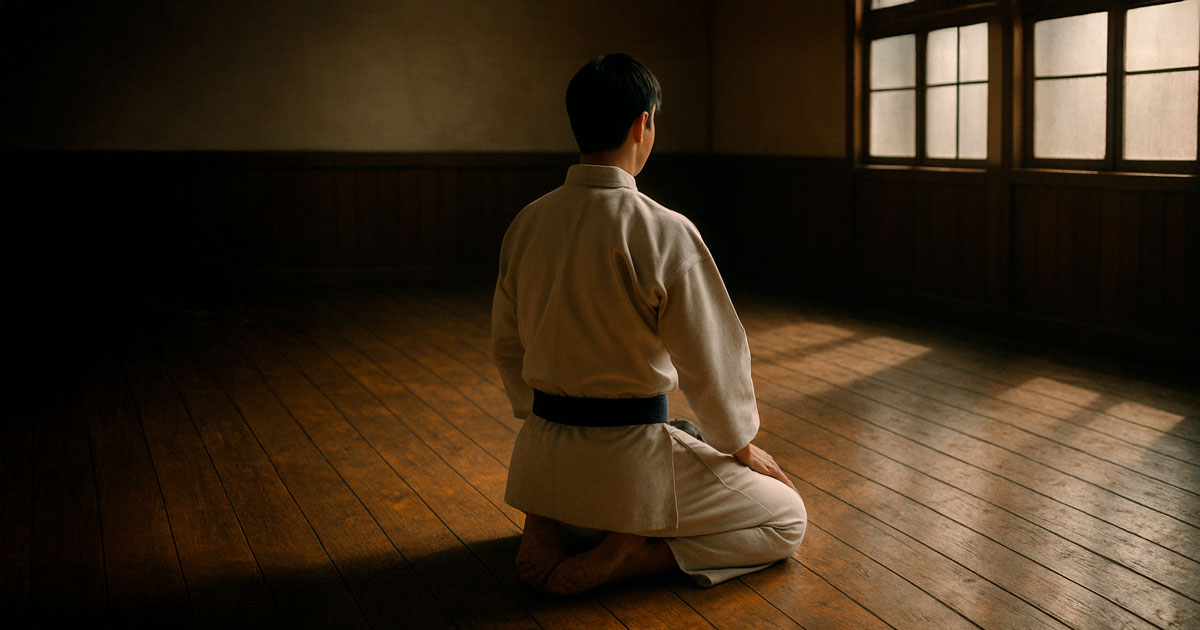
Legs on fire, kneeling on polished wooden floors in a dojo thousands of miles from "home".
Sensei had walked in, seated us in seiza - kneeling upright, feet tucked beneath us - and simply... waited.
For the entire class.
An hour of motionless endurance while our muscles screamed and our feet went completely numb.
Around me, other students shifted and grimaced. Some let out quiet moans as the pain spread up their spines. Others made small sounds of discomfort, breathing heavily through gritted teeth. But no one spoke. No one broke the silence with words.
One of my senpai caught my eye from across the dojo and gave the slightest nod. No words. Just acknowledgment that this was the practice.
This was my first conscious lesson in something I'd been living all my life without knowing there was a word for it.
THE INHERITANCE OF SILENCE
Gaman was never some revelation to me. Growing up in Japan, it was part of the cultural air I breathed, just as common as removing your shoes before entering a home.
My mother whispered it during difficult moments. Teachers expected it without saying a word. Every child understood it: endure the seemingly unbearable with patience and dignity.
What I didn't understand until much later was how that same practice would become my foundation when everything else collapsed.
Later, training in a California dojo, I found myself in an exceptionally long session. My muscles shaking with fatigue, my American training partner leaned over and whispered, "How much longer?" his voice edged with desperation.
"This," I said quietly, "is gaman taikai," a tournament of perseverance.
He looked confused, but nodded politely.
How could I explain that what felt like torture to him was, to me, the practice of a birthright?
Gaman (我慢): to endure the seemingly unbearable with patience and dignity. To bear hardship without complaint. To persevere without bitterness.
It lived in my grandmother's hands as she performed tea ceremony, every movement precise, even with her arthritis. It echoed in the silence between my mother's words when she spoke of leaving Japan. It showed up in how I learned to sleep on floors, in parks, in cramped car seats... without resentment.
This wasn't some exotic philosophy imported from distant temples.
It was the unspoken inheritance of my childhood.
The bridge between my Japanese and European selves.
The invisible architecture that kept me upright when everything else fell apart.
THE SPACE BETWEEN WORLDS
At eight years old, I was the ha-fu kid in rural Japan. Then the foreign oddity in Europe. Always the one who stuck out. The one who didn't quite belong.
I learned early there's no language more universal than a clenched fist. No cultural barrier that can't be crossed with a shove in the schoolyard.
But here's what I've come to understand about being caught between worlds:
You develop a different kind of strength.
Not the loud kind that leaves dents in walls...
but the quiet kind that prevents you from becoming a dent yourself.
By the time I was twelve, I'd already lived multiple lives. Caring for my sister while my father raged against his broken body and broken dreams, I became a master of reading rooms. Of sensing storms before they arrived. Of disappearing when invisibility meant survival.
I learned to take punches, both literal and metaphorical, without letting them change my center of gravity.
"Why are you always so calm?" a friend asked me once, after watching me navigate a turbulent situation without raising my voice.
I didn't have the words back then. I do now.
Calm wasn't a choice. It was a necessity.
Gaman wasn't philosophy, it was survival.
Because when you've been homeless before you're old enough to vote; when you've picked half-eaten sandwiches from overflowing college cafeteria trash bins while smiling at classmates... you develop a different relationship with discomfort.
That's the thing about real endurance.
It's not about being unbreakable.
It's about learning to break in ways that don't shatter you completely.
THE DIGNITY OF EMPTY HANDS
The dojo didn't make me strong.
It gave shape to the strength I already carried.
In the rhythm of forms and techniques, in the discipline of training, I found expression for something I'd been living all along. A way to practice what my body already knew: how to endure.
The night I was thrown out at sixteen, I remember standing at the subway station, carrying everything I dared to take in a small backpack as I dashed out of the house. And somewhere beneath the fear, the heartbreak, the numbness... there was a strange sense of freedom.
A quiet voice that said:
I've already survived worse. I will survive this too.
Gaman taikai. A tournament of perseverance.
Every day since has been part of that tournament.
There were the nights in California; cops knocking on my car window, telling me to move because I couldn't sleep there. Washing in uncleaned bathrooms, reeking of filth. Stretching a few dollars across weeks. Sharing ketchup-packet "spaghetti sauce" we 'sourced' from the local fast food restaurant each week with my roommate - both of us starving, but still showing up to train the next morning.
What kept me going wasn't some noble samurai spirit or enlightened mindset. It was this:
The knowledge that hardship passes.
That dignity isn't something others can take from you.
That survival, sometimes, is victory enough.
THE LONG PRACTICE
I still kneel in seiza every day, feeling that familiar burn spread up my legs. After workouts, in quiet moments, returning to breath.
Not as punishment, but as practice.
A daily reminder that dignity can be cultivated. That endurance is a choice we make again and again.
Some tournaments last a lifetime.
The art isn't in winning... it's in showing up, again and again, with whatever grace you can manage.
Gaman taikai.