
Mindful Eating, Restraint, and Enryo.
I thought they were going to be from Tibet.
A Vietnamese friend had invited me to a Buddhist gathering in Little Saigon (Orange County), and somewhere between my reading the Dalai Lama’s writings and expressing mild interest in an upcoming event with His Holiness, he'd decided I was a seeker, which is how I ended up in a temple full of Vietnamese Buddhist leaders I hadn't known existed, seated among the VIPs because my friend was somebody in this community, nodding along to ceremonies entirely in a language I don't speak, doing my best impression of someone who belonged.
At some point a Vietnamese TV crew showed up. A reporter thrust a microphone in my face and asked me questions I couldn’t properly answer. I smiled. I said something… I have no idea what.
The monks found me during the food portion, a busload of them, passing through Southern California on some kind of goodwill pilgrimage, through the desert to Texas to the East Coast… and for some reason they made straight for the only non-Asian face in the room, which was mine.
Their English was minimal. Didn't matter.
We talked anyway, pointing and gesturing and laughing when something landed, working hard to reach each other across the gap the way you do when language runs out and goodwill is all you have left. There's a particular honesty to a conversation like that.
They wanted to know what I was doing there, where I was from, whether I practiced.
I explained as best I could. Martial arts, Asian heritage, growing up in a multi-cultural multi-religious household that had brought me to this room through a chain of misunderstandings I was still sorting out.
They found this delightful.
They invited me onto their tour bus. We sat together in the rows of seats, robes and all, California afternoon outside the windows, and kept talking in our approximate shared language.
Then they invited me to join them on the road.
“You come with,” they said… All of them gesturing at the open seats, the highway ahead. “Then Europe…” in their heavily accented English.
I was tempted. Really tempted.
My kids were young. I had my job. I said no.
I still think about it though...
I told the story later to a friend I'd met through martial arts, a man from Southeast Asia, a practicing Buddhist his whole life. Still amused by the whole thing, the television camera, the wrong Buddhists, the bus full of monks who wanted to take me across the continent.
We were standing in the parking lot after a long night of training, the way martial artists do… running through things, comparing notes, neither of us in any hurry to leave.
He listened. Then he said: "I was a monk when I was young."
I hadn't known that.
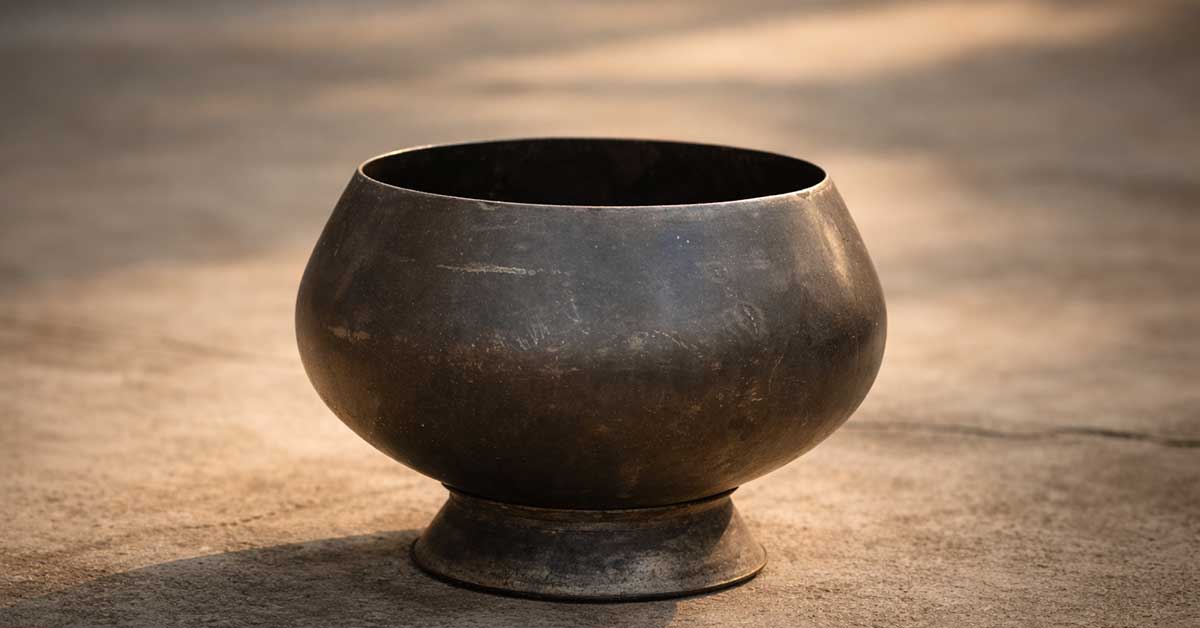
He described the mornings, rising early, going out in small groups through the neighborhood with their begging bowls, receiving whatever people offered, rice or vegetables or whatever they had that day, returning to the monastery, sharing everything among the sangha. That was the meal. Whatever fit in the bowl, divided among the brothers. One meal a day. That’s it. No going back for more… because there weren’t any.
I mentioned I'd been practicing intermittent fasting for a few years… eating within a certain window – typically four to six hours – sometimes only one meal a day.
He nodded. "It's not about when," he said. "It's about how."
I'd been on both ends of that and understood neither. First year in America, first year of college, I was broke enough that I ate from trash cans. Not a metaphor, whatever was there, because that's what it looks like when you arrive somewhere with nothing and hunger doesn't care about your dignity.
Years later I was pushing way past 250 pounds, training martial arts twice a day and eating in my car, standing over the sink at midnight, medicating something I couldn't name with food I never actually tasted.
Two very different situations. The same absence underneath.
He described eating slowly, each bite fully there before the next.
“You are here.”
“This food is here.”
He said that even when the bowl didn't have much in it, eating that way meant he was rarely truly hungry afterward, because the body registers what the mind actually notices later. Most of the time we eat past fullness because we were never really there for the meal in the first place.
The begging bowl gave a boundary that forced presence. You can't eat mindlessly from a single bowl, shared among that many people, received from strangers as an act of their own generosity. Every bite was a privilege.
Years later I read ‘Savor’ by Thich Nhat Hanh, a Zen master writing about mindful eating, and he said essentially the same thing my friend had said in that parking lot after I told him about that busload of monks.
Be present for the bite. The meal is happening now. You are either here for it or you aren't.
I already knew.
My sensei never used the word mindfulness.
What he taught was moderation in all daily habits. Restraint, not as restriction but as the actual point of training, the thing the techniques were always pointing toward. What the practice was really building, year after year, was a person who could regulate himself, who didn't need excess.
He used a word I'd grown up hearing.
Enryo (遠慮).
My grandmother used it. My mother used it.
It's a very Japanese thing, not easily translated.
Something approximating reserve, restraint, but also of not imposing yourself, lowering your own presence so others have room. Not taking the last piece even when you want it, not because you're watching your weight but because taking it makes you a burden, disrupts the harmony of the table, the room, the relationship.
Nothing to do with food specifically. Everything to do with how you move and relate to the rest of the world.
The monk with his begging bowl practiced something that looked like enryo as well… receiving only what was given, letting the bowl set the limit.
My sensei lived both. He didn't need the bowl to set the limit. He'd become the limit. Decades of practice, same habits daily, nothing excessive. He trained and ate and rested and repeated, no drama around any of it. He lived the same way every day until the day became the practice and the practice became the day.
"Never cease training," he said. Not a battle cry or anything that dramatic. More like something you'd say about the simple act of breathing.
The monks I met are long gone.
That was years ago. The bus, the pilgrimage, the temple in Little Saigon, all of it dissolved back into the ordinary flow of things the way those encounters do when you decline the invitation and return to your regularly scheduled programming.
But recently another group of monks walked across the country.
A peace march.
Different tradition, different faces, same road, same bowls probably, same slow deliberate movement through a world that has only gotten crazier since I sat on that bus and almost said yes.
The practice doesn't need me to witness it. It never did.
I think about the bowl sometimes. Not what was in it… just the bowl itself.